13 Oct 2026
Short Odds, Big Misconception: Why Favourites Are Not Guaranteed Winners
A price of 1.20 can look reassuring. WINWIN TIPS explains what short odds mean, why favourites lose and how to read soccer predictions with a clearer head.
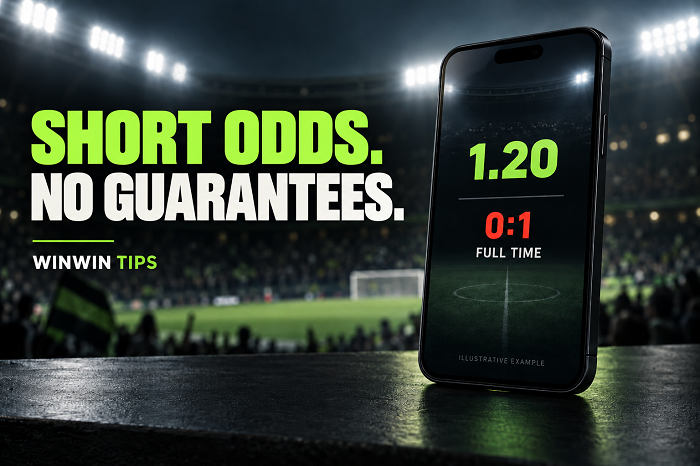
A familiar team, a short price and an opponent that appears weaker on paper: sometimes that is all it takes for a prediction to feel settled before kick-off. The number 1.20 looks reassuring. Yet the match still starts at 0-0, and the price cannot score a goal, defend a corner or prevent a sending-off.
A favourite is the more likely winner according to a particular assessment. It is not a guaranteed winner. At WINWIN TIPS, that distinction is central to reading a prediction sensibly. Whether you follow a major European league or a less familiar competition, the useful question is not simply who is expected to win, but why that expectation might be wrong.
What does a price of 1.20 actually mean?
For decimal odds, dividing 1 by the price gives the raw implied probability. At 1.20, that calculation is approximately 83.3%. This is a conversion of the quoted price, not proof that the team has an objectively verified 83.3% chance of winning. Bookmaker margins and the way the market is priced matter, too.
Even if an event genuinely had an 83.3% chance of happening, there would still be around a 16.7% chance that it did not happen. That does not mean it must fail exactly once in every six matches. Real outcomes do not follow a tidy schedule, and individual fixtures are not interchangeable trials.
The important lesson is simple: a high estimated probability leaves room for failure. A short price changes the potential return; it does not remove uncertainty from the game.
Why a stronger team can still lose
A football match is shaped by more than the relative quality of the squads. A favourite might create chances without finishing them, concede from a set piece or struggle to find space against a well-organised defence. An early goal can change what both teams need to do. A red card can alter the balance again.
There is also a difference between controlling possession and controlling danger. Passing the ball for long periods does not necessarily produce clear opportunities. Meanwhile, an opponent may need only one accurate counterattack to put the favourite under pressure. These are possible match scenarios, not reasons to predict an upset in every game.
Context matters as well. A demanding schedule, changes to the starting team or an important absence can affect how useful an earlier assessment remains. A preview written several days before kick-off should be read with its publication date in mind.
A correct prediction and a good price are different questions
It is tempting to judge a decision entirely by the final score. If the favourite wins, the choice must have been good; if it loses, the analysis must have been worthless. Neither conclusion necessarily follows from one match.
For an illustration, suppose your own estimate gives a team a 75% chance of winning. Decimal odds of 1.20 require a success rate of about 83.3% to break even under a simple fixed-price calculation. Your estimate would therefore not support that price, even though you still think the team is more likely to win than not. The difficulty is that your estimate can also be wrong.
This example is not a staking recommendation or a claim that precise probabilities are easy to calculate. It shows why recognising the likely winner is only one part of evaluating a prediction.
Read free tips for the reasoning, not just the label
When browsing free tips and soccer predictions, look beyond the highlighted selection. A useful preview explains the market, the reasons behind the choice and the conditions that could undermine it. It should make clear whether the assessment is early and whether team news has been confirmed.
You may also see the phrase win tips used for match-winner selections. The wording describes a type of pick; it cannot promise a winning outcome. The same applies to a confident headline or an impressive club name. What matters is the substance of the football analysis beneath it.
Ask whether the explanation relates to this particular fixture. Does it discuss the opponent? Does it acknowledge uncertainty? Could you explain the argument in your own words after reading it? Those questions are more useful than collecting a long list of short-priced favourites.
Does double chance solve the problem?
Double chance covers two of the three normal-time outcomes. For example, 1X succeeds with a home win or a draw, while X2 succeeds with an away win or a draw. That broader coverage usually comes with a lower price than the corresponding win-only selection.
It still leaves a losing outcome. Likewise, choosing goals instead of a winner changes the question rather than removing the risk. Over 2.5 requires at least three goals; both teams to score requires each side to score. A 3-0 result satisfies the first condition and fails the second. The market should fit the reasoning, not merely sound safer.
A clearer way to follow the game
Before accepting a prediction, check the exact market, the age of the analysis and any material team news. Read the possible failure scenario as carefully as the argument in favour. When reviewing results, look across a meaningful record rather than treating one successful day as proof of a system.
At WINWIN TIPS, we want accessible analysis to encourage that more thoughtful approach. Explore our match overview and recorded results, or create a free account to read the available members’ predictions. Already registered? Open Predictions.
Short odds can express confidence. They cannot decide the result. The phone and score on this article’s cover are an illustrative example, not a report of a real fixture.